
Making Bitcoin something you can actually use
Director's messageAtsushi Okada, Director, Japan Bitcoin Industry Inc.
My first encounter with Bitcoin
I learned of Bitcoin's existence around 2013, when I came across internet articles about the so-called Cyprus Shock — the event in which bank deposits were levied and assets shrank, and Bitcoin drew attention as a refuge. But at the time I understood neither its technical mechanics nor its background; it was no more than "so the world has new systems like this," something I regarded from a distance.
An interest born of everyday friction
What actually drew me to Bitcoin was something much closer to daily life. From around 2018, electronic payments spread and completing a payment with just a smartphone became ordinary. Later, when overseas travel became possible again, I began to feel strong discomfort at exchanging money into local currency on every trip. On top of that, I once had a credit card suddenly stop working abroad — I felt firsthand the reality that payments can halt on the judgment of a state or a company. "How convenient it would be to have a payment method usable worldwide, free of censorship and restriction." Thinking that way, my eyes turned naturally to Bitcoin.
What Bitcoin is to me
For me, Bitcoin is neither a symbol for talking philosophy nor an investment product. It is a practical option I can use in daily life when I need it. In the situations where I felt inconvenience — paying abroad, using online services — Bitcoin showed me that another option exists. It is not the best answer in every situation, but there is reassurance in not having to depend solely on the conventional system. And Bitcoin feels less like a finished answer than a system still in trial and error. As usage and surrounding services accumulate, there is room to bring it closer to something people use naturally in daily life — that, too, is part of its appeal.
Making "usable" a reality
At the same time, for all the talk of Bitcoin being "usable," the occasions where it can be used in daily life are still few, and a high hurdle stands between people who want to pay and businesses that want to accept. Preparing wallets, anxiety over price swings, the difficulty of accounting and operations — I felt there were too many practical barriers. That is exactly why I wanted to make Bitcoin not something special, but an option anyone can use naturally — and to build the mechanism for it, I founded Cachet, Inc. Today Cachet has joined the Japan Bitcoin Industry group, and we advance implementation and adoption as one.
Bridging philosophy and practice as a director
I did not decide to become a director because I saw value in the title itself. I wanted to engage with what Japan Bitcoin Industry aims for not from the outside, but in a position that accepts decision-making and responsibility. The company has many members with deep knowledge of Bitcoin's philosophy and historical background. To connect those discussions to real life and concrete use cases, however, a bridge is needed. Continuing to connect philosophy and the field, the ideal and the real — that, I believe, is my role.
What I want to achieve at Japan Bitcoin Industry
What I want to achieve through Japan Bitcoin Industry is neither to promote Bitcoin nor to multiply its supporters. It is to leave society in a state where people can judge calmly, with an understanding of the mechanism — rather than framing Bitcoin as a binary of "for or against," "use it or don't." Even without flash, ensuring that Bitcoin can reliably be used in Japan when needed is Japan Bitcoin Industry's role, and the meaning of the work I carry.
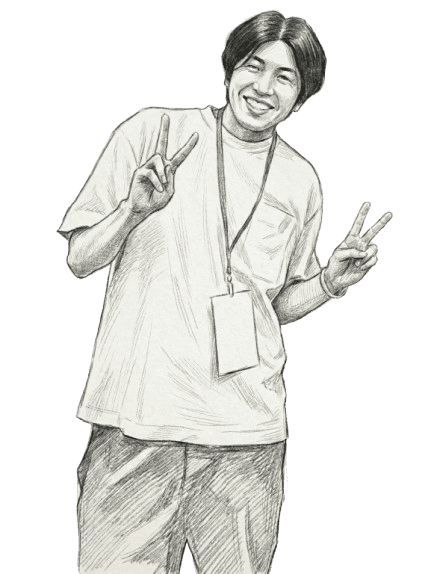
Director
Atsushi Okada
Earned a master's degree at Nagoya City University Graduate School with research applying data analysis. Began his career as a medical-device engineer, then founded a web production company. Payment friction felt while traveling abroad convinced him of Bitcoin's potential; founded Cachet, Inc. in 2023, which joined the group in 2025.