
What is the Lightning Network?
Built on top of Bitcoin, with no token of its own — a payment layer. Just as HTTP is the communication protocol of the web, the Lightning Network is Bitcoin's payment protocol.
The technology that makes Bitcoin payments fast
LN in 30 secondsThe Lightning Network is not a new cryptocurrency. It is technology for sending Bitcoin faster and cheaper.
A fast payment protocol built on Bitcoin
The internet has TCP/IP as its foundation, and HTTP runs the web on top of it. In the same way, the Lightning Network delivers fast payments on top of the Bitcoin foundation.
Pre-funding cuts how often you write to the blockchain
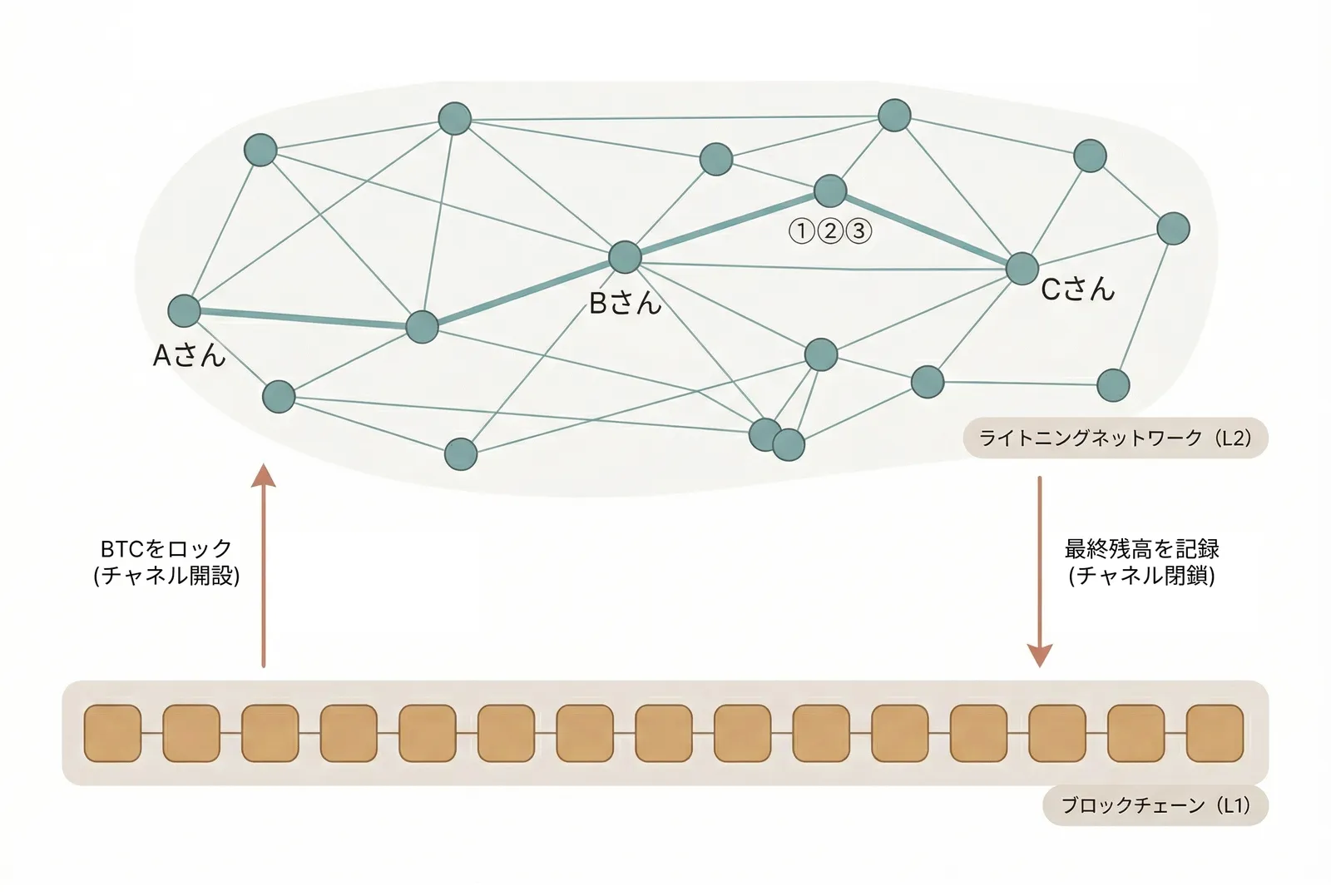
A transit IC card is charged in advance, then settles instantly with a tap at the gate. The Lightning Network has the same structure: once a channel is opened (charged), payments settle instantly without touching the blockchain, and only the final deposits and withdrawals are recorded on Bitcoin's blockchain (the bank).
Simple, because it uses only Bitcoin
The Lightning Network moves Bitcoin itself, so there is no proprietary token and no pegged token issued in exchange for Bitcoin. Anyone can move funds in and out freely.

Compared with familiar payment methods
LN by the numbersLet's compare the Lightning Network's performance with payment methods you know.
| Item | Lightning Network | Credit card | Bank transfer | QR payment |
|---|---|---|---|---|
| Speed | Seconds | Seconds to tens of seconds | 1–3 business days | Seconds |
| Fees | From under ¥1 | 3–5% | From hundreds of yen | 1.6–3.24% |
| International | Instant, low cost | FX fees apply No P2P transfers | Thousands of yen, days | Domestic only |
| 24/7 | Always on | Mostly | Business hours only | Mostly |
| Minimum amount | Under ¥1 possible | Depends on merchant | From ¥1 | From ¥1 |
| Buyer's personal data | Not required | Required | Required | Not required |
| Required partners | Self-contained | Payment processor | Bank account | Payment processor |
The core technology of the Lightning Network
ArchitectureThe four technical elements behind safe, fast payments.
Payment channels
A dedicated payment path opened between two parties. Within a channel you can pay instantly any number of times; only the final balance is recorded on Bitcoin's blockchain. Off-chain processing delivers overwhelming speed.
Multi-hop routing
Pay someone even without a direct channel, via intermediate nodes. If A and C aren't directly connected, funds flow A→B→C through B — instantly.
HTLC (Hash Time-Locked Contracts)
A mechanism combining cryptographic hashes and timelocks. It prevents intermediate nodes from stealing funds and guarantees atomicity — the payment either fully succeeds or fully fails.
Onion routing
The same encryption technique as the Tor network. Each node knows only the hop before and after it; no one can see a payment's full route. Sensitive payment data stays protected.
Lightning Network, spreading worldwide
Global adoptionFrom major U.S. payment companies to peer-to-peer payments in Africa, Lightning Network usage is expanding rapidly around the world.
United States
Major companies like Cash App, Strike, and Coinbase support P2P transfers and deposits/withdrawals. BTC payments have launched at Square merchants.
Switzerland (Lugano)
Under the Plan ₿ initiative, over 350 shops accept LN payments. Even taxes and utilities can be paid in Bitcoin.
Brazil
Latin America's largest Bitcoin ecosystem. Mercado Libre supports BTC.
Africa
Financial inclusion for the unbanked. Growing rapidly as a remittance channel.
South Korea
An active Bitcoin community. LN adoption is advancing alongside crypto regulation.
Kenya
The Tando app enables Lightning payments at every M-Pesa merchant — zero fees, no signup, processing over 100 transactions daily.
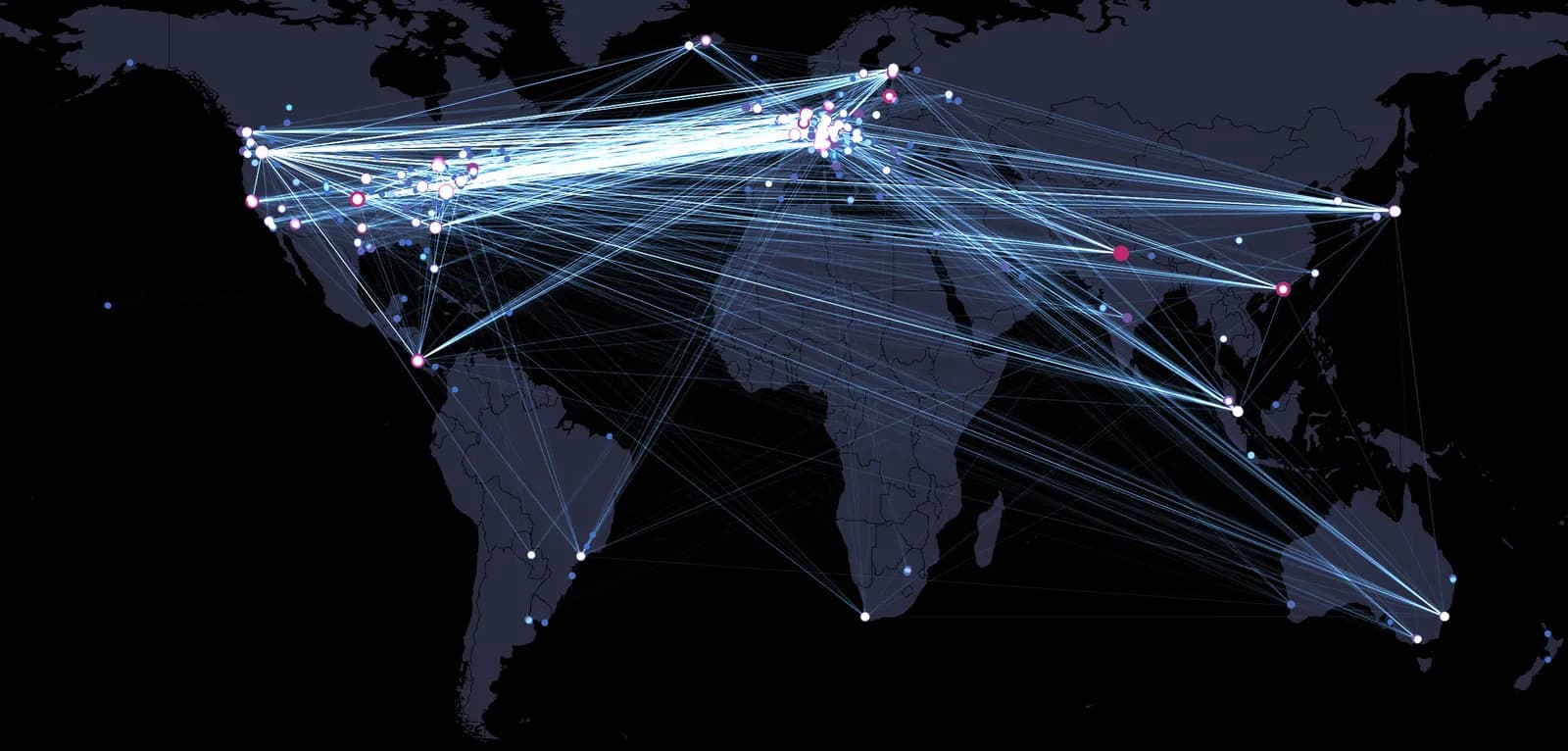
Source: mempool.space - Lightning Network node & channel map
Experience what the Lightning Network makes possible
On the next page, we cover the concrete benefits the Lightning Network brings to your business.